Contents
hide
- (Top)
- Discovery and naming
- Initial finds
- Additional finds
- Neotype
- Description
- Size
- Skull
- Postcranial skeleton
- Classification
- Paleobiology
- Function of neural spines
- Diet and feeding
- Aquatic habits
- Locomotion and posture
- Ontogeny
- Palaeopathology
- Paleoecology
- Bahariya Formation
- Kem Kem Beds
- In popular culture
- See also
- References
- Further reading
- External links
Spinosaurus
Appearance hideText
Width
Color


From Wikipedia, the free encyclopedia
Spinosaurus (
/ˌspaɪnəˈsɔːrəs/; lit. 'spine lizard') is a
genus of large
spinosaurid theropod dinosaurs that lived in what is now
North Africa during the
Cenomanian age of the
Late Cretaceous period, about 100 to 94 million years ago. The genus was known first from Egyptian remains discovered in 1912 and described by German
palaeontologist Ernst Stromer in
1915. The original remains were destroyed in
World War II, but additional material came to light in the early 21st century. It is unclear whether one or two species are represented in the fossils reported in the scientific literature. The
type species,
S. aegyptiacus, is mainly known from the
Bahariya Formation in Egypt and the
Kem Kem beds in Morocco. The other species,
S. mirabilis, is known from the
Farak Formation in Niger. Possible
junior synonyms include
Sigilmassasaurus and the
dubious S. maroccanus from the Kem Kem beds and
Oxalaia from the
Alcântara Formation in
Brazil, though the distinction and validity of these
taxa have been debated.
Spinosaurus is among the largest known terrestrial
carnivores; other large carnivores comparable to
Spinosaurus include theropods such as
Tyrannosaurus,
Giganotosaurus and the contemporary
Carcharodontosaurus. A 2022 study suggests that
S. aegyptiacus could have reached 14 m (46 ft) in length and 7.4 t (8.2 short tons) in body mass. The skull of
Spinosaurus was long, low, and narrow, similar to that of a modern
crocodilian, and bore straight conical teeth with few to no
serrations. It would have had large, robust forelimbs bearing three-fingered hands, with an enlarged claw on the first
digit. The distinctive
neural spines of
Spinosaurus, which were long extensions of the
vertebrae, grew to at least 1.65 m (5.4 ft) long and were likely to have had skin connecting them, forming a
sail-like structure. The hip bones of
Spinosaurus were reduced, and the legs were very short in proportion to the body. Its long and narrow tail was deepened by tall, thin neural spines and elongated
chevrons, forming a paddle-like structure.
Spinosaurus is known to have eaten both aquatic and terrestrial prey. Evidence suggests that it was
semiaquatic, although the extent of its swimming capability has been strongly contested.
Spinosaurus's leg bones had a high bone density, allowing for better
buoyancy control. Multiple functions have been put forward for the dorsal sail, including
thermoregulation and
display; either to intimidate rivals or attract mates. It lived in a humid environment of
tidal flats and
mangrove forests alongside many other dinosaurs as well as fish,
crocodylomorphs,
squamates, turtles,
pterosaurs, and
plesiosaurs.
Discovery and naming
Initial finds

Plate I of elements of the
S. aegyptiacus holotype (name-bearing) specimen from
Stromer (1915)
The first discovery of
Spinosaurus may have been in October 1898, when French
geologist Fernand Foureau unearthed two unusual
teeth in
Cenomanian-aged
sediments of the
Djoua Escarpment in what is now southern Algeria, then
French Algeria.
[4][5] Foreau found the specimens while on the
Foureau-Lamy Expedition of 1898-1900, which traveled across the
Sahara from Algeria to
Lake Chad. In 1905, French geologist
Emile Haug described the fossils unearthed while on the expedition, including the two teeth which he assigned to the
fish Saurocephalus.
[4] However, in 1915 German
paleontologist and describer of
Spinosaurus Ernst Stromer reassigned the teeth to
Spinosaurus.
[6] Later studies have agreed with this assessment, however the teeth themselves has since been lost.
[5][7]The first confidently referable remains of
Spinosaurus were discovered in the autumn of 1912 by
Austro-Hungarian paleontologist
Richard Markgraf, a fossil collector who was financed by Stromer and the
Bavarian Academy of Sciences, in deposits of the
Bahariya Formation in the
Bahariya Oasis of western Egypt. The sediments of the Bahariya Formation come from the Cenomanian stage of the
Late Cretaceous period, one of many
Cretaceous-aged
formations of
North Africa.
[8] In 1915, Stromer
described these remains as belonging to a new
genus and
species of
dinosaur,
Spinosaurus aegyptiacus. The generic name
Spinosaurus comes from the
Latin spina, meaning "spine", and the
Greek sauros, meaning "lizard", and thus "spine lizard". The specific name
aegyptiacus derives from Egypt, where the fossils were unearthed.
[6][9] Spinosaurus aegyptiacus'
type specimen (BSP 1912 VIII 19) consists of elements of the
mandible (lower jaw), a
maxilla (upper jaw) fragment,
cervical (neck),
caudal (tail), and
dorsal (back)
vertebrae, including much of the
neural spines,
ribs, teeth, and some
gastralia (belly ribs).
[6][10]In April 1914, another expedition to the Bahariya Oasis by Markgraf unearthed an incomplete skeleton (BSP 1922 X45) of a
spinosaurid. This skeleton was poorly preserved and, as a result of illegal unpacking and insufficient repacking by
Anglo-Egyptians during
World War I, was greatly damaged. After much deliberation due to the war and poor
Anglo-German relations,
[11]: 102–108 the skeleton arrived in Germany in 1922 where it was described by Stromer in 1934. Stromer assigned the skeleton to
Spinosaurus, but considered it different enough from
S. aegyptiacus that it would belong to its own
Spinosaurus species,
"Spinosaurus B".
[12]
Erhardt's 1936 skeletal reconstruction of
S. aegyptiacus, with shaded areas being known parts of the
holotypeIn 1936, Stromer worked with Dr. Erhardt (the first name is unknown) to create a skeletal reconstruction of
Spinosaurus based on fossils of the holotype, "
Spinosaurus B", and related taxa. Although Stromer was hesistant about the lack of known remains, he and Erhardt produced a restoration that filled in missing elements of
Spinosaurus' skeleton with the tyrannosaurid theropods
Tyrannosaurus and
Gorgosaurus.[10][13]: 86–87 Unfortunately, during the night of April 24/25, 1944, the building of the
Paläontologisches Museum München (Bavarian State Collection of Paleontology) of the Bavarian Academy of Sciences was severely damaged during the
British Bombing of Munich. Due to personal and political tensions between Stromer and the museum's
curator, who was a fervent
Nazi, the
Spinosaurus fossils held there were not rehoused and subsequently destroyed as a result of the bombing. Stromer's finds, including
Spinosaurus, received little academic or public attention. In 1995, Stromer's son donated his father's archives to the Paläontologische Staatssammlung München, leading to a 2006 study by American researcher Joshua Smith and colleagues of the photographs, two of which were of
Spinosaurus' holotype. Based on these photographs of the mandible and the entire specimen as mounted, Smith concluded that Stromer's original 1915 drawings were slightly inaccurate.
[9] No more spinosaurid material would be described from Africa until the latter half of the 20th century, with
Spinosaurus remaining an enigmatic and mysterious theropod.
[14][15]Additional finds
Beginning in the 1980s,
Spinosaurus material began being described from sites in Algeria, Morocco, and Tunisia, although these fossils were often isolated and fragmentary.
[16][17][2] In 1986, a paper referred several teeth found in Cretaceous deposits in Tunisia to
Spinosaurus, being the first evidence of the taxon's existence in the country.
[18] In 1989, French paleontologist
Eric Buffetaut assigned two jaw fragments and a tooth that had been unearthed in a deposit of the Kem Kem Beds in
Taouz, Morocco to
Spinosaurus sp., expanding the known distribution of the genus to Morocco.
[16] In the 1990s, a wealth of spinosaurid remains were described from South America, Asia, Africa, and Europe, strengthening the understanding of
Spinosaurus and Spinosauridae.
[19][20][2] However, much of the anatomy of
Spinosaurus still remained obscure and many studies proposed that fossils previously assigned to the genus or
Sigilmassasaurus were actually from
iguanodont ornithischians,
[21][22] megaraptorans,
[23] carcharodontosaurids,
[24] or other forms of theropod.
[23]Additional fossils of
Spinosaurus were recovered from the
Kem Kem Beds in the
Tafilalt Oasis of Morocco, near the site of the ancient city of
Sigilmassa. In 1996, Canadian paleontologist
Dale Russell described these fossils, consisting of three cervical vertebrae, two mandible fragments, and the neural spine of a dorsal vertebra, as belonging to a new species of
Spinosaurus,
S. maroccanus. The specific name,
maroccanus, derives from
royaume du Maroc ("
Kingdom of Morocco"), where the fossils were unearthed. The site where
S. maroccanus' fossils were found is located in the south of the country and made up of red
sandstone, known by various names, including the
Grès rouges infracénomaniens, Continental Red Beds, and lower Kem Kem Beds. Of these fossils, one cervical vertebra (cataloged at the Canadian Museum of Nature as NMC 50791), was selected as the holotype of
S. maroccanus.
[25]
Holotype of
S. maroccanus which was later reclassified as a vertabrae of the controversial
SigilmassasaurusS. maroccanus was differentiated from
S. aegyptiacus based on the length of its neck vertebrae. Specifically, Russell claimed that the ratio of the length of the
centrum (body of vertebra) to the height of the posterior
articular facet was 1.1 in
S. aegyptiacus and 1.5 in
S. maroccanus.
[25] Later authors have been split on this topic, with some authors noting that the length of the vertebrae can vary from individual to individual, that the holotype specimen was destroyed and thus cannot be compared directly with the
S. maroccanus specimen, and that it is unknown which cervical vertebrae the
S. maroccanus specimens represent. Therefore, though some have retained the species as valid without much comment,
[26][27][28] most researchers regard
S. maroccanus as a
nomen dubium (dubious name),
[29][1][30] a
junior synonym of
S. aegyptiacus,[24][31] or a junior synonym of
Sigilmassasaurus brevicollis.
[32] Some studies have referred to the holotype and other referred specimens of
S. maroccanus (NMC 50791 and MNHN SAM 124–128) as
S. cf.
aegyptiacus.
[33][34] The specimens previously ascribed as
paratypes of
S. maroccanus (NMC 41768 and NMC 50790) were reidentified as spinosaurid specimens that are currently not identifiable at the generic level.
[32][35]In 1996, a study by American paleontologist
Paul Sereno and colleagues assigned cervical vertebrae referred to "
Spinosaurus B" and the spinosaurid
Sigilmassasaurus (a possible synonym of
Spinosaurus)
[14][3][36] to the carcharodontosaurid
Carcharodontosaurus. This was based on the erroneous belief that a cervical vertebra (SGM Din-3) found nearby a
skull of
Carcharodontosaurus (SGM Din-1) belonged to the same individual. Sereno and colleagues also reasoned that stout cervicals like those of
Sigilmassasaurus would be needed to carry the skulls of carcharodontosaurids,
[37] however later analyses have proven that "
Spinosaurus B" and
Sigilmassasaurus are not synonyms or contain fossils from
Carcharodontosaurus.[22][23] Some studies have continued to refer "
Spinosaurus B" to
Sigilmassasaurus, although this is still debated.
[25][24] In 2003, Oliver Rauhut suggested that Stromer's
Spinosaurus holotype (name-bearing) specimen was a
chimera, composed of vertebrae and neural spines from a
carcharodontosaurid similar to
Acrocanthosaurus and a mandible from
Baryonyx or
Suchomimus,[30] an analysis that was rejected in at least one subsequent paper.
[29]Neotype

Digital skeletal reconstruction of
Spinosaurus, showing known bones based on the
holotype (red), proposed
neotype (blue), and referred specimens (yellow), according to Sereno et al. (2022)
In 2008, a Moroccan fossil collector based in
Erfoud presented a few fragmentary dinosaur fossils to Italian paleontologist
Nizar Ibrahim, who suspected they may belong to
Spinosaurus. The next year, several other fossils, constituting a partial skeleton, were acquired by the
Museo di Storia Naturale di Milano (MSNM) from an Italian
fossil dealer who had purchased them from the same who showed the remains to Ibrahim the previous year. Later, Ibrahim visited the MSNM and was presented the material by Italian paleontologists
Cristiano Dal Sasso and
Simone Maganuco.
[38] Ibrahim recognized that the MSNM fossils and the ones he had seen in 2008 were from a similar sandstone matrix and that the neural spines of the MSNM fossils were similar to those depicted by Stromer in 1915, leading him to think that they may be from the same individual and belonged to
Spinosaurus.
[39][40]Following this, an international collaboration began between Ibrahim and other paleontologists to study the bones and visit the original site, with fossils from the MSNM getting sent to the
University of Chicago for study.
[14][40] In 2013, Ibrahim, Moroccan paleontologist Samir Zouhri, and British paleontologist
David Martill ventured to
Casablanca in search of the original fossil dealer, who they were able to track down.
[41] Subsequently, the dealer took them back to the site where the fossils had been found. Over the course of several years, a skeleton of a subadult individual consisting of skull fragments, some cervical, dorsal, and caudal vertebrae, neural spines, a complete
sacrum, much of the
hindlimbs, several
pedal phalanges, and several dorsal ribs was unearthed. This skeleton comes from a locality of the Douria Formation of the Kem Kem Beds in
Zrigat, Morocco, dated to the Cenomanian stage of the mid-Cretaceous period.
[42][14] It was deposited at the Casablanca Museum under specimen number FSAC-KK-11888.
[14]
Geographical setting of the
Kem Kem region and outcrops, with Kem Kem and Guir Hamadas outcrops in red.
In 2014, Ibrahim and colleagues assigned the fossils to
S. aegyptiacus, proposed it the
neotype (replacement holotype), and stated that all North African Cenomanian spinosaurid material belongs to
S. aegyptiacus. The description of these remains were met with intrigue, surprise, and controversy, as the authors claimed that
Spinosaurus was a possibly
quadrupedal,
semiaquatic, short-limbed spinosaurid.
[14][40] The body proportions of the specimen have been debated, as the hind limbs are disproportionately shorter in the specimen than in previous reconstructions. However, it has been demonstrated by multiple paleontologists that the specimen is not a chimera, and is indeed a specimen of
Spinosaurus that suggests that the animal had much smaller hind limbs than previously thought.
[14][43][44][45]In 2015, British paleontologist Serjoscha Evers and colleagues rejected the neotype proposal for FSAC-KK-11888 on the basis of the lack of association or locality information for FSAC-KK-11888, the geographical separation between the holotype and FSAC-KK-11888 localities, and anatomical differences between FSAC-KK-11888 and the holotype. Evers and colleagues argue for the validity of both
S. marrocanus and
S. aegyptiacus, stating that FSAC-KK-11888 likely belongs to the former. Additionally, they state that the geographical separation of FSAC-KK-11888 and the holotype as well as the detailed description of the holotype by Stromer are evidence that FSAC-KK-11888 does not meet the
ICZN (International Code of Zoological Nomenclature)'s requirements for a neotype and that the creation of a neotype is unnecessary for
S. aegyptiacus.
[32] Additionally, some paleontologists have suggested that the proportions of the dorsal vertebrae compared to the legs of FSAC-KK-11888 when compared to the proportions of "
Spinosaurus B" illustrate that either the former is a composite (a specimen composed of multiple individuals of the same species)/
chimera (a specimen composed of material from two or more species) between an individual known from dorsal vertebrae and an individual known from limb,
pelvic, and
tail material or that FSAC-KK-11888 is not from
Spinosaurus.
[46][32]Between 2015 and 2019, several additional expeditions to the site unearthed additional fossils of FSAC-KK-11888 including many caudal vertebrae, composing about 80% of the tail with a preserved length of 4 m (13 ft), elements of the
pes and hindlimbs, skull fragments, and more. Around 90% of this new material was found in late 2018, whereas some fragments including cranial material were found in debris of previous expeditions. In 2020, Ibrahim and colleagues described the tail of FSAC-KK-11888, which they stated closely compares to the caudal vertebrae of the holotype and
"Spinosaurus B". The material found on these expeditions perfectly matches elements of the FSAC-KK-11888, proving that they come from a single individual.
[36] The body length of the proposed neotype excluding the tail portion, from the anterior tip of the skull to the posterior region of the pelvic girdle, is estimated up to 5.88 m (19.3 ft),
[14]Table S1 and the total length of the tail is estimated up to 5.3 m (17 ft).
[36]Description
Size

Size comparison of selected giant theropod dinosaurs,
S. aegyptiacus in red
Since its discovery,
Spinosaurus has been a contender for the largest theropod dinosaur.
[47] Both
Friedrich von Huene in 1926
[48] and
Donald F. Glut in 1982 listed it as among the most massive theropods in their surveys, at 15 m (49 ft) in length and upwards of 6 t (6.6 short tons) in weight.
[49] In 1988,
Gregory S. Paul also listed it as the longest theropod at 15 m (49 ft), but gave a lower mass estimate of 4 t (4.4 short tons).
[50]
Estimated size of the largest known, holotype, neotype, and smallest known specimen with a human
In 2005, Dal Sasso and colleagues assumed that
Spinosaurus and the related
Suchomimus had the same body proportions in relation to their skull lengths, and estimated that
Spinosaurus was 16 to 18 m (52 to 59 ft) long and weighed 7 to 9 t (7.7 to 9.9 short tons).
[29] In their 2007 paper using scaling to extrapolate theropod body size based on skull length, François Therrien and Donald Henderson challenged previous estimates of the size of
Spinosaurus. Based on estimated skull lengths of 1.5 to 1.75 m (4 ft 11 in to 5 ft 9 in), they estimated a body length of 12.6 to 14.3 m (41 to 47 ft) and a body mass of 12 to 20.9 t (13.2 to 23.0 short tons); they also suggested that contrary to Dal Sasso et al. (2005), their scaling based on a 11 m (36 ft) long
Suchomimus would produce an estimated body mass of 11.7 to 16.7 t (12.9 to 18.4 short tons). The lower estimates for
Spinosaurus would imply that the animal was shorter and lighter than
Carcharodontosaurus and
Giganotosaurus.
[51] In 2020, Nicolás Campione and David Evans suggested to take caution with the approach using skull length for extrapolation, namely that of
Spinosaurus, since the preorbital region of some dinosaurs grow allometrically (disproportionately with body size) and the cranial properties were likely under different selection pressures unrelated to body size.
[52]In 2014, Ibrahim and his colleagues suggested that an adult
Spinosaurus aegyptiacus could reach over 15 m (49 ft) in length.
[14] In 2022, however, Paul Sereno and his colleagues suggested that
Spinosaurus aegyptiacus reached a maximum body length of 14 m (46 ft) and a maximum body mass of 7.4 t (8.2 short tons) by constructing a CT-based 3D skeletal model "with the axial column in neutral pose."
[53] They argued that the 2D graphical reconstruction of the aquatic hypothesis by Ibrahim and his colleagues in 2020
[42] overestimated the presacral column length by 10%, ribcage depth by 25%, and forelimb length by 30% over dimensions based on CT-scanned fossils; these proportional overestimates shift the center of mass anteriorly when translated to a flesh model, and thus the estimate from Ibrahim and his colleagues cannot be considered a reliable body size estimate.
[53]Skull

Annotated diagram of the reconstructed skull of
Spinosaurus
Annotated diagram of the reconstructed skull muscles of
SpinosaurusIts skull had a narrow snout filled with straight conical teeth that lacked serrations. There were six or seven teeth on each side of the very front of the upper jaw, in the premaxillae, and another twelve in both maxillae behind them. The second and third teeth on each side were noticeably larger than the rest of the teeth in the premaxilla, creating a space between them and the large teeth in the front of the maxilla; large teeth in the lower jaw faced this space. The very tip of the snout holding those few large front teeth was expanded, and a small crest was present in front of the eyes. Using the dimensions of three specimens known as MSNM V4047, UCPC-2, and BSP 1912 VIII 19, and assuming that the postorbital region of MSNM V4047 had a shape similar to the postorbital region of
Irritator, Dal Sasso et al. (2005) estimated that the skull of an adult
Spinosaurus was 1.75 meters (5.7 ft) long,
[29] but Hendrickx et al. (2016) suggested that a length of 1.6 meters (5.2 ft) is more likely.
[31] The estimated skull length of the subadult neotype is up to 1.12 meters (3.7 ft).
[14]Table S1 A 2026 study analyzed cranial material of two Spinosaurids, including two specimans referred to the controversial species
S. maroccanus, their findings were interpreted as indicative of a highly developed, sensitive neurovascular system and a high tooth replacement rate in Spinosaurids from a young age.
[54]Postcranial skeleton
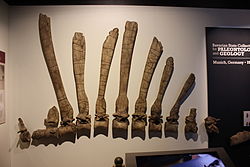
Reconstructed replicas of the holotype
vertebrae,
National Geographic Museum,
Washington, D. C.As a spinosaurid,
Spinosaurus would have had a long, muscular neck, curved in a
sigmoid, or S-shape. Its shoulders were prominent, and the forelimbs large and stocky, bearing three clawed
digits on each hand. The first finger (or "thumb") would have been the largest.
Spinosaurus had long
phalanges (finger bones), and only somewhat recurved
claws, suggesting that its hands were longer compared to those of other spinosaurids.
[14][55][20]Very tall neural spines growing on the back vertebrae of
Spinosaurus formed the basis of what is usually called the animal's "
sail". The lengths of the neural spines reached over 10 times the diameters of the centra (vertebral bodies) from which they extended.
[56][57] The neural spines were slightly longer front to back at the base than higher up, and were unlike the thin rods seen in the
pelycosaur finbacks such as
Edaphosaurus, Ianthasaurus and
Dimetrodon, contrasting also with the thicker spines in the
iguanodontian Ouranosaurus.
[56] Life restorationSpinosaurus
 sails were unusual, although other dinosaurs, namely
Ouranosaurus, which lived a few million years earlier in the same general region as
Spinosaurus, and the
Early Cretaceous South American sauropod
Amargasaurus, might have developed similar structural adaptations of their vertebrae. The sail may be an
analog of the sail of the
Permian synapsid Dimetrodon, which lived before the dinosaurs even appeared, produced by
convergent evolution.
[56]The structure may also have been more hump-like than sail-like, as noted by Stromer in 1915 ("one might rather think of the existence of a large hump of fat [
German:
Fettbuckel], to which the [neural spines] gave internal support")
[6] and by Jack Bowman Bailey in 1997.
[56] In support of his "buffalo-back" hypothesis, Bailey argued that in
Spinosaurus,
Ouranosaurus, and other dinosaurs with long neural spines, the spines were relatively shorter and thicker than the spines of
pelycosaurs (which are known to have sails); instead, the dinosaurs' neural spines were similar to the neural spines of extinct hump-backed mammals such as
Megacerops and
Bison latifrons.
[56][58] In 2014,
Ibrahim and colleagues instead posited that the spines were covered tightly by skin, similar to a
crested chameleon, given their compactness, sharp edges, and likely poor
blood flow.
[14]Spinosaurus had a significantly smaller pelvis than that of other giant theropods, with the surface area of the ilium half that of most members of the clade. The hind limbs were short, at just over 25 percent of the total body length, with the tibia being longer than the femur. Unlike in other theropods, the hallux (or fourth toe) of
Spinosaurus touched the ground, and the phalanges of the toe bones were unusually long and well-built. At their ends were shallow claws that had flat bottoms. This type of foot
morphology is also seen in
shorebirds, indicating that
Spinosaurus's feet evolved for walking across unstable substrate and that they may have been
webbed.
[14]From the
caudal vertebrae of the tail projected significantly elongated, thin neural spines, akin to the condition observed in some other spinosaurids,
[55] though to a more extreme degree. Coupled with the also elongated
chevron bones on the underside of the caudals, this resulted in a deep and narrow tail with a paddle or fin-like shape, comparable to the tails of
newts and
crocodilians.
[36]Classification

Restoration of various
spinosaurids that did not live in the same time or space;
Spinosaurus,
Baryonyx,
Irritator and
SuchomimusSpinosaurus is the type genus of the family
Spinosauridae, subfamily Spinosaurinae, and tribe Spinosaurini.
[55][24][26] Spinosaurinae includes
Spinosaurus, Oxalaia and
Sigilmassasaurus (which may be synonyms of
Spinosaurus),
[3] Irritator, Angaturama (which may be synonymous with
Irritator)
[24][29][1] and possibly
Ichthyovenator,[55][59] Siamosaurus,
[55][60] and
Camarillasaurus.[61] Spinosaurini is defined as a clade including all spinosaurids closer to
Spinosaurus aegyptiacus than
Irritator challengeri and
Oxalaia quilombensis, which are distinguished from spinosaurins due to their less elongate premaxillae and premaxillae which are excluded from the
external naris.
[55] Spinosauridae was a clade named by Stromer for just
Spinosaurus. Stromer noted some similarities of
Spinosaurus to other theropods known at the time like
Dryptosaurus and
Tyrannosaurus, however due to the unique and specialized nature of
Spinosaurus' teeth, vertebrae, and jaw he opted to put it in its own clade of theropods. Stromer proposed that
Streptospondylus and
Antrodemus (now
Allosaurus) were possible
ancestors of
Spinosaurus, but stated that the remains of
Spinosaurus were too fragmentary to be sure.
[6] From the 1920s to 1980s,
Spinosaurus was typically classified as the sole member of Spinosauridae, a
megalosaurid, or a
carnosaur.
[62] However, some studies by paleontologists like American researcher
Alfred Romer included the high-spined theropods
Acrocanthosaurus and
Altispinax in Spinosauridae based on their tall neural spines.
[63][64][65] This has not been supported by later studies, which typically classify these taxa as members of
Carcharodontosauridae or Allosauroidea instead of Spinosauridae.
[66][67][68]In 1986, British paleontologists
Alan Charig and
Angela Milner described
Baryonyx, which they considered distinct enough to be classified in its own family of theropod dinosaurs: Baryonychidae.
[69] However, in 1988 American paleontologist Gregory S. Paul argued that
Baryonyx and
Spinosaurus were related based on their notched snouts and stated they may be late-surviving dilophosaurids.
[15] In a 1989 paper, Buffetaut supported this conclusion, stating that they were both piscivorous, related theropods.
[16] Descriptions of
Irritator, Cristatusaurus, and other spinosaurids (as well as additional fossils of
Spinosaurus) led to the realization of a transcontinental clade of spinosaurids.
[1][19][2] As more spinosaurids were named, the interrelationships of Spinosauridae became better understood. In 1998, Sereno and colleagues described
Suchomimus, a spinosaurid from the Cretaceous of Niger. In their description, Sereno and colleagues defined Spinosauroidea as a clade including spinosaurids and
torvosaurids, however this clade is considered synonymous with
Megalosauroidea,
[70] and Spinosauridae as a clade composed of spinosauroids closer related to
Spinosaurus aegyptiacus than
Torvosaurus tanneri. Additionally, Sereno and colleagues recognized the existence of two subfamilies within Spinosauridae:
Baryonychinae, which included
Suchomimus and
Baryonyx, and Spinosaurinae, which included
Spinosaurus and
Irritator.
[24] In 2004, American researcher Thomas Holtz and colleagues defined Spinosaurinae as including all spinosaurids closer related to
Spinosaurus aegyptiacus than
Baryonyx walkeri.
[26][20] The spinosaurines share unserrated straight teeth that are widely spaced (e.g., 12 on one side of the maxilla), as opposed to the baryonychines, which have serrated curved teeth that are numerous (e.g., 30 on one side of the maxilla).
[29][sup][url=
en.wikipedia.org/wiki/Spinosaurus#ci




 Plate I of elements of the S. aegyptiacus holotype (name-bearing) specimen from Stromer (1915)
 Erhardt's 1936 skeletal reconstruction of S. aegyptiacus, with shaded areas being known parts of the holotype
 Holotype of S. maroccanus which was later reclassified as a vertabrae of the controversial Sigilmassasaurus
 Digital skeletal reconstruction of Spinosaurus, showing known bones based on the holotype (red), proposed neotype (blue), and referred specimens (yellow), according to Sereno et al. (2022)
 Geographical setting of the Kem Kem region and outcrops, with Kem Kem and Guir Hamadas outcrops in red.
 Size comparison of selected giant theropod dinosaurs, S. aegyptiacus in red
 Estimated size of the largest known, holotype, neotype, and smallest known specimen with a human
 Annotated diagram of the reconstructed skull of Spinosaurus
 Annotated diagram of the reconstructed skull muscles of Spinosaurus
 Reconstructed replicas of the holotype vertebrae, National Geographic Museum, Washington, D. C.
 Life restoration
 Restoration of various spinosaurids that did not live in the same time or space; Spinosaurus, Baryonyx, Irritator and Suchomimus