

• 9/18/26 10:50 am
- 18 views
- Progress
- 100% complete
- 1
- 0

0
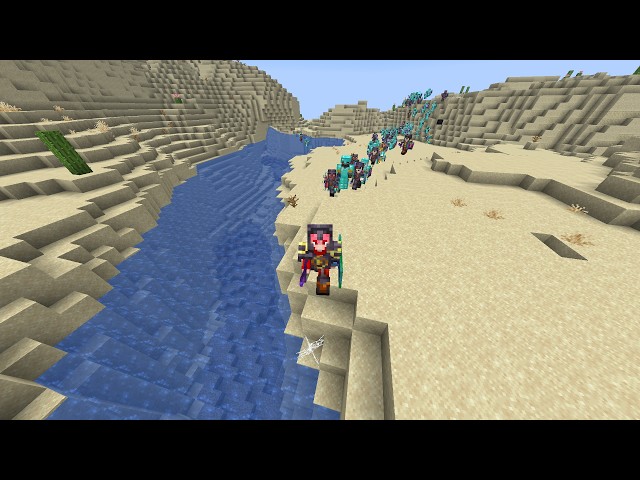
My first Minecraft map is a large and highly customisable war simulator set in a massive desert. The main idea behind the map is to give players the freedom to create their own battles and scenarios instead of forcing them to follow one specific story. I wanted to make something that could be played again and again while still feeling different each time. The map is made up of a huge desert with rivers running through it, villages spread across the landscape, and large hills that give the environment more variety. These features are not only there to make the map look interesting, but can also become important parts of the battles that players create.
The desert is the main environment of the map. It gives the battlefield a large, open feeling and provides plenty of space for armies to move around. There are areas where players can set up large battles without being restricted by buildings or other obstacles. The open desert can also make armies easier to see from a distance, creating a completely different experience from fighting in a forest or a city. At the same time, the desert is not completely flat or empty. The rivers, villages, and hills break up the landscape and give players different locations to use when planning their battles.
One of the most noticeable features of the map is the large hills. These hills can become very important during a battle because they provide elevated areas overlooking the surrounding desert. Players can use them as defensive positions, observation points, or important objectives. A battle over a hill could be very different from a battle in the middle of the desert. An army controlling a hill may have a better view of the battlefield, while another army may have to attack from lower ground. This gives players more opportunities to experiment with different strategies.
The rivers are another important part of the map. They run through parts of the desert and create natural barriers between different areas. A river can change the way an army moves across the battlefield because soldiers cannot simply move through the water as easily as they can across the sand. This can turn a river into an important defensive position. Players might choose to defend a crossing or attempt to capture one. They could also build their own bridges or use existing parts of the environment to create different ways of crossing.
The villages scattered throughout the desert are also important locations. They make the map feel more like a real world rather than simply a large empty area made for fighting. Villages can provide interesting locations for players to build battles around. One scenario could involve one army defending a village while another attempts to capture it. Another scenario could have two armies meeting near a village while the players decide what happens next. Because the map is customisable, there are many different possibilities.
The biggest feature of the map is its customisation. I wanted players to have control over their own battles rather than simply playing through a battle that I had completely planned for them. The idea is that the player can decide how they want the battlefield to be used and what kind of scenario they want to create. This makes the map much more flexible than a traditional Minecraft adventure map.
For example, a player could create a battle between two armies in the middle of the desert. Another player could place the armies on opposite sides of a river and make the river crossing the main objective. Someone else could create a battle around one of the villages, or have an army attempt to take control of one of the large hills. These scenarios could all take place on the same map but feel very different because of how the player sets them up.
This customisation also makes the map highly replayable. A normal map might have a battle that is exactly the same every time someone plays it. Once the player completes it, they already know what is going to happen. My map is designed to avoid that problem by allowing players to change the way their battles work. They can try different setups and see how the results change. Even if they use the same part of the desert, they can create a completely different battle there.
Another goal of the map is to encourage players to experiment. There does not have to be only one correct way to use the battlefield. Players can test different ideas and create unusual scenarios just to see what happens. They might create a large battle involving several groups, a small battle around a village, or a defensive scenario where one side has to hold a position for as long as possible. The map gives them the environment and tools they need to create these situations themselves.
The size of the map is also important. Because it is a large desert, there is plenty of room for battles to spread out. Players do not have to fight in one small area. An army could start near a village, move across the desert, cross a river, and eventually reach a large hill. This means that a single battle could involve several different parts of the map. The battlefield can change as the battle progresses, which makes the environment feel more important.
Making this map as my first Minecraft map has been a learning experience as well. Creating a large environment requires a lot of planning. I have had to think about where the rivers should go, where the villages should be placed, and how the hills should fit into the desert. I also have to consider how players will move around the map and whether different areas are useful for creating battles. Building the environment is only one part of the project because the customisation features also need to work properly.
One of the things I like about making a war simulator is that I can continue adding new features in the future. Since the map is designed around customisation, there are many possibilities for expanding it. I could add new areas to the desert, create more villages, add different types of terrain, or introduce new ways for players to set up their battles. The map does not have to stay exactly the same as it is now. It can continue growing as I learn more about Minecraft map-making.
The map is also a way for me to be creative. Instead of only playing Minecraft maps made by other people, I get to create my own world and decide how it works. I can choose the environment, design the battlefield, and think about how players will interact with it. Even though this is my first map, I want it to feel like something that has its own identity rather than just being a basic Minecraft world.
Overall, my first Minecraft map is a large desert war simulator focused on freedom, strategy, and customisation. The massive desert provides open areas for large battles, while the rivers create natural obstacles, the villages provide important locations, and the large hills create elevated positions that can become key parts of a battle. All of these features work together to create a battlefield that players can use in many different ways.
The most important part of the map is that players are not limited to one experience. They can create their own scenarios, change the way battles are set up, experiment with different strategies, and play the same map in completely different ways. This makes the map more than just a battlefield. It is a sandbox where players can create their own conflicts and stories.
As my first Minecraft map, this project is also the beginning of my experience with creating custom worlds. There is still plenty that I can improve and add, but that is part of what makes the project exciting. I can continue learning, expanding the map, and adding more customisation options. My goal is for the map to become a place where players can spend a lot of time creating different battles and seeing how they play out. Instead of telling players exactly what to do, I want to give them the tools to make their own battles and decide what happens on the battlefield.
The desert is the main environment of the map. It gives the battlefield a large, open feeling and provides plenty of space for armies to move around. There are areas where players can set up large battles without being restricted by buildings or other obstacles. The open desert can also make armies easier to see from a distance, creating a completely different experience from fighting in a forest or a city. At the same time, the desert is not completely flat or empty. The rivers, villages, and hills break up the landscape and give players different locations to use when planning their battles.
One of the most noticeable features of the map is the large hills. These hills can become very important during a battle because they provide elevated areas overlooking the surrounding desert. Players can use them as defensive positions, observation points, or important objectives. A battle over a hill could be very different from a battle in the middle of the desert. An army controlling a hill may have a better view of the battlefield, while another army may have to attack from lower ground. This gives players more opportunities to experiment with different strategies.
The rivers are another important part of the map. They run through parts of the desert and create natural barriers between different areas. A river can change the way an army moves across the battlefield because soldiers cannot simply move through the water as easily as they can across the sand. This can turn a river into an important defensive position. Players might choose to defend a crossing or attempt to capture one. They could also build their own bridges or use existing parts of the environment to create different ways of crossing.
The villages scattered throughout the desert are also important locations. They make the map feel more like a real world rather than simply a large empty area made for fighting. Villages can provide interesting locations for players to build battles around. One scenario could involve one army defending a village while another attempts to capture it. Another scenario could have two armies meeting near a village while the players decide what happens next. Because the map is customisable, there are many different possibilities.
The biggest feature of the map is its customisation. I wanted players to have control over their own battles rather than simply playing through a battle that I had completely planned for them. The idea is that the player can decide how they want the battlefield to be used and what kind of scenario they want to create. This makes the map much more flexible than a traditional Minecraft adventure map.
For example, a player could create a battle between two armies in the middle of the desert. Another player could place the armies on opposite sides of a river and make the river crossing the main objective. Someone else could create a battle around one of the villages, or have an army attempt to take control of one of the large hills. These scenarios could all take place on the same map but feel very different because of how the player sets them up.
This customisation also makes the map highly replayable. A normal map might have a battle that is exactly the same every time someone plays it. Once the player completes it, they already know what is going to happen. My map is designed to avoid that problem by allowing players to change the way their battles work. They can try different setups and see how the results change. Even if they use the same part of the desert, they can create a completely different battle there.
Another goal of the map is to encourage players to experiment. There does not have to be only one correct way to use the battlefield. Players can test different ideas and create unusual scenarios just to see what happens. They might create a large battle involving several groups, a small battle around a village, or a defensive scenario where one side has to hold a position for as long as possible. The map gives them the environment and tools they need to create these situations themselves.
The size of the map is also important. Because it is a large desert, there is plenty of room for battles to spread out. Players do not have to fight in one small area. An army could start near a village, move across the desert, cross a river, and eventually reach a large hill. This means that a single battle could involve several different parts of the map. The battlefield can change as the battle progresses, which makes the environment feel more important.
Making this map as my first Minecraft map has been a learning experience as well. Creating a large environment requires a lot of planning. I have had to think about where the rivers should go, where the villages should be placed, and how the hills should fit into the desert. I also have to consider how players will move around the map and whether different areas are useful for creating battles. Building the environment is only one part of the project because the customisation features also need to work properly.
One of the things I like about making a war simulator is that I can continue adding new features in the future. Since the map is designed around customisation, there are many possibilities for expanding it. I could add new areas to the desert, create more villages, add different types of terrain, or introduce new ways for players to set up their battles. The map does not have to stay exactly the same as it is now. It can continue growing as I learn more about Minecraft map-making.
The map is also a way for me to be creative. Instead of only playing Minecraft maps made by other people, I get to create my own world and decide how it works. I can choose the environment, design the battlefield, and think about how players will interact with it. Even though this is my first map, I want it to feel like something that has its own identity rather than just being a basic Minecraft world.
Overall, my first Minecraft map is a large desert war simulator focused on freedom, strategy, and customisation. The massive desert provides open areas for large battles, while the rivers create natural obstacles, the villages provide important locations, and the large hills create elevated positions that can become key parts of a battle. All of these features work together to create a battlefield that players can use in many different ways.
The most important part of the map is that players are not limited to one experience. They can create their own scenarios, change the way battles are set up, experiment with different strategies, and play the same map in completely different ways. This makes the map more than just a battlefield. It is a sandbox where players can create their own conflicts and stories.
As my first Minecraft map, this project is also the beginning of my experience with creating custom worlds. There is still plenty that I can improve and add, but that is part of what makes the project exciting. I can continue learning, expanding the map, and adding more customisation options. My goal is for the map to become a place where players can spend a lot of time creating different battles and seeing how they play out. Instead of telling players exactly what to do, I want to give them the tools to make their own battles and decide what happens on the battlefield.
7051870
2




 CraftyFoxe
 CristalixBuildTeam
 MazaVili
 ENDOoOo

Have something to say?