


• 1/28/26 6:38 am
- 754 views • 3 today
- save_alt 115 downloads
- Game Version
- Minecraft 1.7.10
- Progress
- 100% complete
6
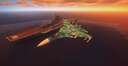
In the 1980s, even before the Su-25 attack aircraft began mass production, the Soviet military realized that an air support aircraft that could only perform close range air support missions during the day and had limited ability to use guided air to ground weapons would be difficult to meet the needs of future modern battlefields. The Soviet military hoped to obtain an air support aircraft that could perform missions day and night at altitudes of 30 to 4500 meters in areas 450 kilometers away from the front line of the theater. They can attack enemy mobile and fixed targets, air defense systems, helicopters, transport planes, and small ships on the surface. This military demand is seen as Russia's response to the Western proposal of being able to operate continuously day and night, attack enemy areas at the same depth and target, and accurately strike enemy second tier air support aircraft.
To meet the military's requirements, Sukhoi developed the T-8M (i.e. Su-25T) program based on its proposal in the early 1980s. The first prototype Su-25T developed under the T-8M program made its maiden flight in 1984. Later, the design bureau produced eight Su-25T pre production aircraft in the 1990s based on several prototypes it had already developed. Subsequently, based on the prototype Su-25T, it was renamed Su-25TM by enhancing its weapon system and avionics system, and finally named Su-39 attack aircraft.
In 1995, the Sukhoi Design Bureau of Russia produced a total of three Su-39 prototypes.
In 1997, the development of the Su-39 was completed and flight tests began according to the Russian Air Force's test plan
To meet the military's requirements, Sukhoi developed the T-8M (i.e. Su-25T) program based on its proposal in the early 1980s. The first prototype Su-25T developed under the T-8M program made its maiden flight in 1984. Later, the design bureau produced eight Su-25T pre production aircraft in the 1990s based on several prototypes it had already developed. Subsequently, based on the prototype Su-25T, it was renamed Su-25TM by enhancing its weapon system and avionics system, and finally named Su-39 attack aircraft.
In 1995, the Sukhoi Design Bureau of Russia produced a total of three Su-39 prototypes.
In 1997, the development of the Su-39 was completed and flight tests began according to the Russian Air Force's test plan
More like this
![[MCheli] Su-25 UKRAINE 1.7.10 Pack Minecraft Mod](https://static.planetminecraft.com/files/image/minecraft/mod/2024/201/17549120_s.jpg) [MCheli] Su-25 UKRAINE 1.7.10 PackMinecraft 1.7.10 Other Mod
[MCheli] Su-25 UKRAINE 1.7.10 PackMinecraft 1.7.10 Other Mod AcronixUA
•2/15/24 9:33
5.5k 1.3k 4x 62018
AcronixUA
•2/15/24 9:33
5.5k 1.3k 4x 62018 Mcheli Su-30SM/Cu-30MkMinecraft 1.7.10 Other Mod
 Post_Soviet_Player
•11/26/23 10:32
3.8k 826 4x 31013
Post_Soviet_Player
•11/26/23 10:32
3.8k 826 4x 31013![[MCheli]Su25-SM Content Package Minecraft Mod](https://static.planetminecraft.com/files/image/minecraft/mod/2024/101/18153359_s.jpg)

 dtc10e
6813740
7











![Modern Kill Feed [TaCZ / SBW / PB] Minecraft Mod](https://static.planetminecraft.com/files/image/minecraft/mod/2026/101/20169595_s.jpg)
 Tjopix
 CarrotNoRanch
 Mokey Crue
 DalgaMan
 NuclearCharm
Have something to say?